Physiotherapy · Elbow · Racket Sports
Tennis Elbow Explained
Causes, Rehabilitation & Physiotherapy in Singapore
Pain on the outside of your elbow whenever you grip your racket, carry a bag, lift a weight or even pick up a coffee cup? You may be experiencing tennis elbow — also known as lateral elbow tendinopathy or lateral epicondylalgia.
Despite the name, you do not actually have to play tennis to develop tennis elbow. It commonly affects people whose work, sport, gym training or daily activities repeatedly load the muscles and tendons around the outside of the elbow.
At NXS Collective in Singapore, we approach tennis elbow rehabilitation by looking beyond the painful area alone. Strength, load tolerance, activity demands, training volume and the way your upper limb is functioning can all matter. The goal is not simply to make pain disappear — it is to understand why the elbow is painful, improve what it can tolerate and progressively build you back towards the activities you want to do.
Understanding the condition
What is tennis elbow?
Tennis elbow is a condition involving pain and reduced function around the outside of the elbow, where several of the forearm extensor muscles attach. These muscles play an important role whenever you grip, carry, lift, control the wrist or use a racket.
Persistent tennis elbow is better understood as a tendinopathy rather than simply an “inflamed tendon”. Changes in tendon structure, muscle function, motor control and pain processing may all contribute to symptoms. This is why the solution is not always to stop using the arm completely.
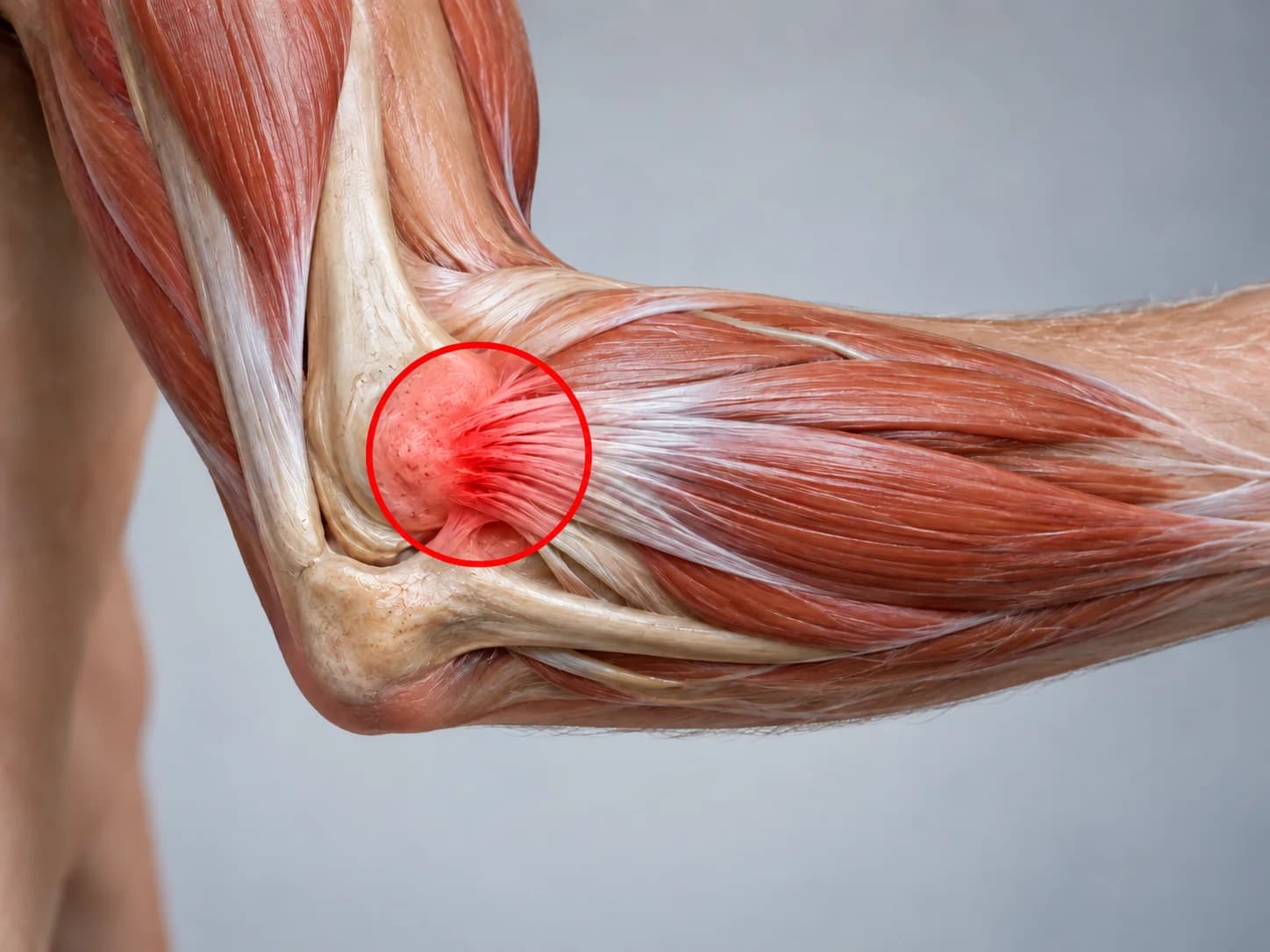
Rehabilitation often involves finding an appropriate level of activity while progressively improving the elbow's ability to tolerate load.
Common presentation
What does tennis elbow feel like?
The most common symptom is pain or tenderness around the bony prominence on the outside of the elbow. Some people also notice that their grip feels weaker on the painful side.
- Gripping or squeezing an object
- Carrying shopping bags
- Lifting a kettle or water bottle
- Opening a jar or turning a door handle
- Using a mouse or performing repetitive work
- Extending your wrist against resistance
- Gym exercises that involve gripping
- Hitting a tennis or other racket-sport shot
Pain-free grip strength is one of the measures that may be assessed during an evaluation of lateral elbow tendinopathy, alongside other measures of strength and function.
Load & capacity
What causes tennis elbow?
There usually is not one single cause. A useful way to think about tennis elbow is a mismatch between how much load your elbow is currently exposed to and how much load it is currently prepared to tolerate.
Someone may normally play tennis once per week without any issue, then begin playing three times per week, enter a tournament and increase gym training at the same time. The elbow suddenly has to tolerate considerably more work than it is accustomed to.
The same can happen outside sport. Repetitive gripping, lifting, manual work or a sudden increase in unfamiliar activity can increase the demand placed on the forearm muscles and tendons. Treating tennis elbow is therefore not always about identifying one “damaged” structure. Understanding what changed and how the arm is responding to that load can be equally important.
Tennis & racket sports
Why is tennis elbow common in tennis and racket sports?
During tennis, your hand, wrist, elbow, shoulder and trunk work together to transfer force through the racket. The forearm muscles repeatedly stabilise the wrist while you grip the racket and strike the ball.
A sudden increase in playing volume, more intense training or repeatedly performing movements that provoke symptoms can increase the demands placed on the elbow. But the elbow does not work in isolation.
- Shoulder strength
- Forearm and wrist strength
- Grip strength
- Shoulder and elbow movement
- Training volume
- Which strokes provoke symptoms
- Frequency of play
- Recent changes in training or equipment
The intention is not to blame every case of tennis elbow on the shoulder or your tennis technique. It is to understand why your particular elbow may be overloaded.
Activity modification
Can I continue playing tennis with tennis elbow?
Not necessarily. Complete rest is not automatically required for everyone with tennis elbow. How much tennis you can continue playing depends on how irritable your symptoms are, how much pain you experience while playing, how the elbow responds afterwards, your current playing volume and what else is loading the arm.
The aim is not simply: “Don't use your arm until it stops hurting.”
The aim is to find an amount of activity the elbow can currently tolerate and then progressively build its capacity again.
Rehabilitation
Should you exercise with tennis elbow?
Exercise is commonly used in the management of tennis elbow. The 2022 clinical practice guideline for lateral elbow pain recommends resisted isometric, concentric and/or eccentric wrist-extensor exercise for people with subacute or chronic lateral elbow tendinopathy.
Research has also found that exercise tends to perform better than passive interventions, although the overall effects reported across studies are relatively modest and the certainty of evidence varies. There is no single magical “tennis elbow exercise”.
A rehabilitation programme may begin with progressively strengthening the wrist extensors and other forearm muscles. For someone returning to a racket sport, rehabilitation may later progress towards stronger gripping under load, faster movements, upper-limb strengthening and sport-specific demands.
Is strengthening only the elbow enough?
Not always. Someone who mainly needs to type comfortably at work has very different requirements from someone aiming to return to competitive tennis. This is one reason we assess the individual rather than simply give everyone the same three tennis-elbow exercises. Shoulder and scapular strengthening may also be incorporated when relevant impairments are identified.
Treatment options
Where do dry needling, shockwave and manual therapy fit?
Exercise and progressive loading are important components of tennis elbow rehabilitation, but they are not necessarily the only tools that may be used. Depending on your symptoms, how irritable the elbow is and how long the problem has been present, dry needling, shockwave therapy and manual therapy may sometimes be incorporated alongside rehabilitation.
An important distinction is that we do not view these treatments as replacements for strengthening. They may be used to help manage symptoms and improve function while progressively rebuilding the capacity of the elbow and upper limb.
Dry needling for tennis elbow
Dry needling involves inserting a thin, sterile needle into selected muscles, trigger points or other targeted tissues without injecting medication. For someone with tennis elbow, it may be directed towards relevant muscles of the forearm depending on the assessment and technique being used.
A 2024 systematic review and meta-analysis involving 17 randomised controlled trials and 979 participants reported improvements in pain, elbow-related disability, grip strength and upper-limb function, with short-term pain improvement particularly evident following treatment. Earlier research has also reported improvements, while noting variability in the certainty and consistency of the evidence.
Dry needling can therefore be a useful option for selected patients, but it should not necessarily be viewed as a standalone cure.
Shockwave therapy for tennis elbow
Shockwave therapy has been investigated for persistent lateral elbow tendinopathy. Research has reported improvements in pain and grip strength following extracorporeal shockwave therapy compared with some control treatments.
One review comparing shockwave therapy with corticosteroid injection reported better short-term outcomes for corticosteroid injection at one month, while shockwave therapy produced better pain, grip-strength and functional outcomes at three and six months.
This does not mean shockwave is necessary for everyone with tennis elbow. Where appropriate, it may form part of a broader rehabilitation strategy while strength and load tolerance continue to be rebuilt.
Manual therapy and soft-tissue treatment
Manual therapy and soft-tissue techniques may also be used for short-term symptom management. One approach studied in people with tennis elbow is mobilisation with movement, where a physiotherapist applies a specific joint mobilisation while the patient performs a movement such as gripping.
Research has reported improvements in pain and grip strength following mobilisation-with-movement approaches. The intention is not to rely on passive treatment alone, but to use symptom-modifying treatment where appropriate while progressively rebuilding function and capacity.
Recovery
How long does tennis elbow take to recover?
There is no single recovery timeline. Some cases settle relatively quickly, while others can persist for months.
- How long you have experienced symptoms
- How irritable the elbow currently is
- The demands of your work or sport
- How frequently the elbow continues to be aggravated
- Your current strength and physical capacity
- Whether activity can be appropriately modified
- How consistently rehabilitation can be progressed
Two people can experience pain in almost exactly the same location but still have very different rehabilitation requirements. The more useful question is often whether the elbow is gradually becoming more capable of tolerating the things you need it to do.
When to seek assessment
When should you see a physiotherapist for tennis elbow?
Not every pain around the outside of the elbow is tennis elbow. Problems involving other structures around the elbow, the neck or nerves can sometimes produce similar symptoms.
- Pain is persistent or progressively worsening
- Normal daily activities are becoming difficult
- Your grip has noticeably weakened
- Symptoms repeatedly return whenever you resume sport
- The pain is significant or does not behave like a typical overuse problem
- You experience numbness or tingling
- You are unsure whether the symptoms are actually coming from the elbow
A physiotherapy assessment can help determine whether your symptoms are consistent with tennis elbow and identify factors that may be contributing to the problem.
NXS Collective
Tennis elbow physiotherapy at NXS Collective Singapore
Our approach is not simply to tell you to rest your elbow and hand you a generic sheet of exercises. We first want to understand why your elbow hurts, what is loading it, what it can currently tolerate and what you eventually need it to be able to do.
01
Understanding your symptoms and activity
When did the pain begin? What movements provoke it? Has your tennis, gym training or work volume recently changed?
02
Elbow and forearm assessment
We assess structures and movement around the elbow to determine whether the presentation is consistent with tennis elbow or whether another condition should be considered.
03
Objective strength testing
Where appropriate, we may assess strength around the elbow, wrist and shoulder to identify meaningful deficits and side-to-side differences.
04
Looking beyond the elbow
For racket-sport athletes, we may assess other parts of the upper limb involved in producing and transferring force during sport.
05
Building your return-to-sport plan
Rather than simply waiting for pain to disappear, rehabilitation progressively rebuilds the strength and load tolerance needed for the activities that matter to you.
Still playing through elbow pain?
Get your elbow properly assessed.
If elbow pain is affecting your tennis, gym training, work or everyday activities, you do not necessarily have to choose between “just rest it” and “keep playing and hope it goes away”. A physiotherapy assessment can help establish what may be contributing to the problem and build a structured plan towards the activities you want to return to.
View Our Availability
Book PhysiotherapyNot sure if physiotherapy is the right next step? Speak with Samuel through a complimentary physiotherapy phone consultation.
Request a Complimentary CallThe phone consultation is intended for initial guidance only and does not replace an in-person physiotherapy assessment or medical diagnosis.
Evidence base
References
- Lucado AM, Day JM, Vincent JI, et al. Lateral Elbow Pain and Muscle Function Impairments: Clinical Practice Guidelines. Journal of Orthopaedic & Sports Physical Therapy. 2022;52(12). doi:10.2519/jospt.2022.0302.
- Karanasios S, Korakakis V, Moutzouri M, et al. Exercise interventions in lateral elbow tendinopathy have better outcomes than passive interventions, but the effects are small: a systematic review and meta-analysis of 2123 subjects in 30 trials. British Journal of Sports Medicine. 2021.
- Yoon SY, Kim YW, Shin IS, Kang S, Moon HI, Lee SC. The beneficial effects of eccentric exercise in the management of lateral elbow tendinopathy: a systematic review and meta-analysis. Journal of Clinical Medicine. 2021;10(17):3968.
- Heales LJ, Bout N, Dines B, et al. An investigation of maximal strength of the upper limb bilaterally in individuals with lateral elbow tendinopathy: a systematic review with meta-analysis. Physical Therapy. 2021;101(12).
- Ma X, Qiao Y, Wang J, Xu A, Rong J. Therapeutic Effects of Dry Needling on Lateral Epicondylitis: An Updated Systematic Review and Meta-analysis. Archives of Physical Medicine and Rehabilitation. 2024;105(11):2184–2197.
- Navarro-Santana MJ, Sanchez-Infante J, Fernández-de-Las-Peñas C, Cleland JA, Martín-Casas P, Plaza-Manzano G. Effects of trigger point dry needling on lateral epicondylalgia of musculoskeletal origin: a systematic review and meta-analysis. Clinical Rehabilitation. 2020.
- Yao G, Chen J, Duan Y, Chen X. Efficacy of Extracorporeal Shock Wave Therapy for Lateral Epicondylitis: A Systematic Review and Meta-Analysis. BioMed Research International. 2020;2020:2064781.
- Karanasios S, Tsamasiotis GK, Michopoulos K, Sakellari V, Gioftsos G. Clinical effectiveness of shockwave therapy in lateral elbow tendinopathy: systematic review and meta-analysis. Clinical Rehabilitation. 2021;35(10):1383–1398.
- Lucado AM, Dale RB, Vincent J, Day JM. Do joint mobilizations assist in the recovery of lateral elbow tendinopathy? A systematic review and meta-analysis. Journal of Hand Therapy. 2019;32(2):262–276.e1.
- Evaluating the Effectiveness of Deep Transverse Frictional Massage Combined with Conventional Physiotherapy for Tendinopathies: A Systematic Review and Meta-analysis. 2025.
This article is intended for general educational purposes and does not replace an individual medical or physiotherapy assessment.